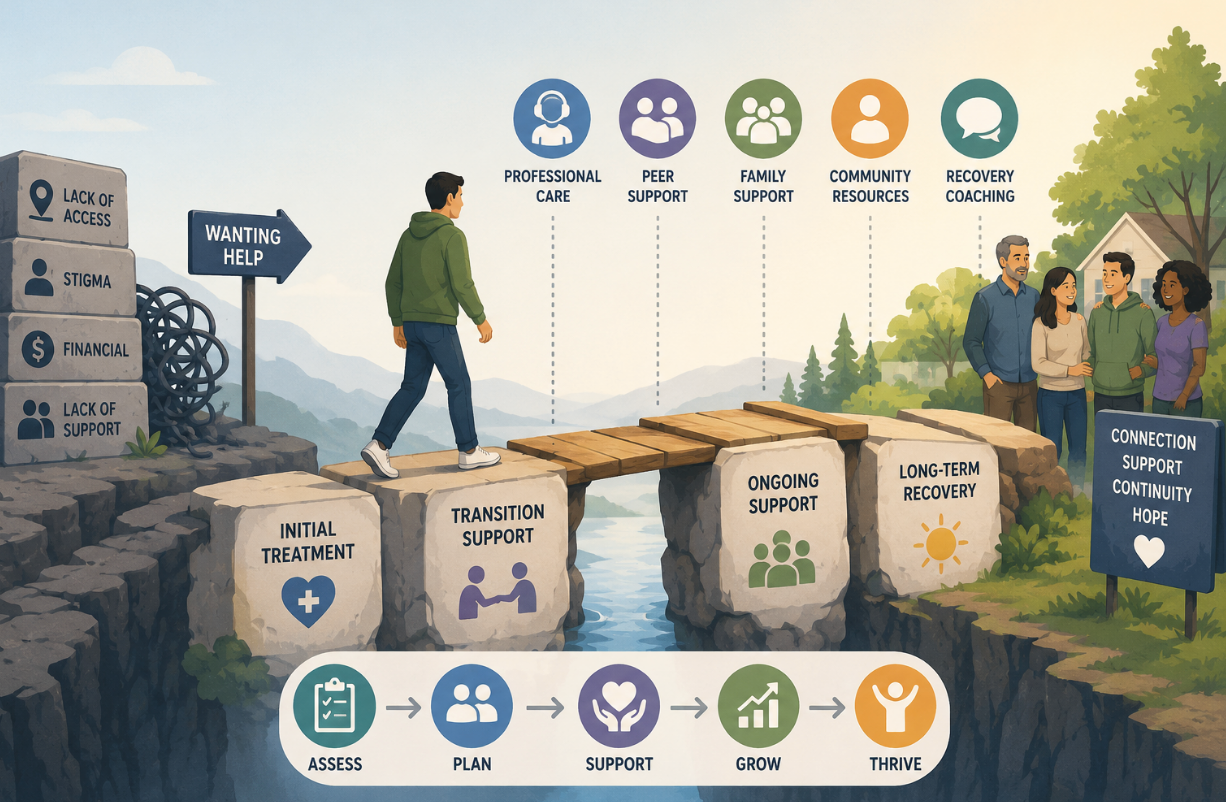
Addiction recovery is rarely a straight path. For many people, it looks more like a series of transitions—some planned, others unexpected—where access to care, the strength of support systems, and continuity of treatment can either stabilize progress or create setbacks. When any one of these elements breaks down, the recovery journey can feel fragmented. Bridging those gaps is not just a clinical challenge; it’s a human one.
The reality behind “continuity of care”
Continuity of care is often discussed in healthcare systems, but in addiction recovery, it takes on a deeper meaning. It’s not just about moving from one stage of treatment to another—it’s about ensuring that the person remains supported, understood, and connected throughout each phase.
In real life, however, continuity can be disrupted. Someone may complete a detox program but struggle to access outpatient support afterward. Another individual might begin therapy but drop off due to transportation issues, financial strain, or lack of follow-up. These interruptions are not signs of failure—they’re signs that the system has gaps.
True continuity means more than appointments on a calendar. It includes emotional consistency, trusted relationships, and a clear sense of “what comes next” at every stage of recovery.
Access: The first and most visible barrier
Access is often the starting point of the conversation, and for good reason. If care cannot be accessed in the first place, recovery cannot begin.
Barriers to access come in many forms:
- Geographic limitations, especially in rural or underserved areas
- Long wait times for treatment entry
- Financial constraints and insurance complexity
- Limited availability of specialized care
- Stigma that discourages individuals from seeking help
In many communities, these barriers overlap. For example, someone living in a rural area may need to travel long distances for treatment while also navigating limited transportation options and financial pressure. Each barrier adds friction to the recovery process.
Even when services exist, they are not always easy to enter. The gap between “wanting help” and “receiving help” can be wide enough to discourage someone from continuing to try.
The missing middle: what happens after initial treatment
A common gap in recovery systems appears after initial stabilization or treatment. This “missing middle” is where individuals are no longer in intensive care but are not yet fully independent in their recovery journey.
This stage is often where support matters most. Without structured guidance, individuals may feel uncertain about how to maintain progress. Questions like “What now?” or “Who do I turn to if things get harder?” become critical.
Effective recovery pathways ensure that this transition is not abrupt. Instead, they provide stepping stones such as outpatient therapy, peer support, recovery coaching, and community-based resources. These supports help bridge the psychological gap between structured treatment and everyday life.
Support systems: more than professional care
Support in addiction recovery extends far beyond clinical environments. While therapists, counselors, and medical professionals play a vital role, long-term recovery is often sustained through a broader network.
This includes:
- Family members learning how to provide healthy support without enabling harmful patterns
- Peer groups offering shared understanding and lived experience
- Community programs that reduce isolation
- Mentors or recovery coaches who provide ongoing guidance
However, support systems are not always naturally strong. In some cases, relationships may be strained due to past behaviors, misunderstanding of addiction, or emotional exhaustion. Rebuilding trust takes time, and not everyone has immediate access to supportive environments.
That’s why integrated recovery approaches increasingly emphasize community connection alongside clinical care. Recovery is more stable when individuals feel they are not navigating it alone.
The importance of personalized recovery pathways
One of the most overlooked gaps in addiction care is the assumption that recovery should follow a uniform path. In reality, recovery is highly individual. What works for one person may not work for another.
Personalized recovery pathways consider factors such as:
- Mental health history and co-occurring conditions
- Social environment and housing stability
- Employment or educational responsibilities
- Cultural background and personal values
- Previous experiences with treatment
When care is tailored, individuals are more likely to remain engaged. When it is rigid or generalized, drop-off rates tend to increase.
A flexible system allows people to move between levels of care as needed, rather than forcing them into a fixed sequence. This adaptability is key to closing gaps that often lead to relapse or disengagement.
Stigma as a silent barrier
Even when services are available and accessible, stigma continues to be one of the most powerful barriers to continuity in recovery.
Stigma can come from outside—society, workplaces, or even healthcare settings—but it can also become internalized. Many individuals carry feelings of shame that make it harder to seek ongoing help or admit when they are struggling.
This silence can interrupt recovery progress. People may stop attending support sessions, avoid follow-ups, or delay seeking help during setbacks.
Addressing stigma requires both cultural and systemic change. Education, open dialogue, and compassionate care environments all play a role in making recovery feel safer and more sustainable.
Building bridges through coordinated care
Bridging gaps in addiction recovery requires coordination at every level. When healthcare providers, community organizations, and support systems are aligned, individuals experience fewer disruptions in care.
Effective coordination includes:
- Clear transition plans between treatment stages
- Follow-up after discharge or program completion
- Communication between different care providers
- Easy pathways back into care if relapse occurs
- Consistent emotional and practical support systems
A well-connected system recognizes that recovery is not linear. Setbacks may happen, and when they do, re-entry into care should be simple, not complicated.
In some structured recovery frameworks, such as those associated with models like Wisconsin Recovery Institute, continuity and coordinated care are emphasized as part of a broader recovery philosophy. The focus is not just on short-term stabilization, but on long-term support that adapts to real-life challenges.
Technology and modern recovery support
Digital tools are increasingly helping to close gaps in care. Telehealth appointments, recovery tracking apps, and virtual support groups allow individuals to stay connected even when physical access is limited.
These tools are especially valuable for people in remote areas or those balancing work and family responsibilities. While technology cannot replace human connection, it can strengthen it by making support more consistent and accessible.
However, digital solutions also require equity considerations. Not everyone has reliable internet access or comfort with technology, so they must complement—not replace—traditional support systems.
A more connected vision of recovery
At its core, bridging gaps in addiction recovery is about connection. Connection between stages of care, between people and providers, and between individuals and their support networks.
When those connections are strong, recovery becomes more stable and sustainable. When they are weak or fragmented, individuals are left to navigate complex challenges on their own.
Improving access, strengthening support systems, and ensuring continuity are not separate goals—they are parts of the same foundation. A recovery journey supported at every stage is not only more effective but also more humane.
And ultimately, the goal is not just to help someone begin recovery, but to help them remain supported long after the first step is taken.